
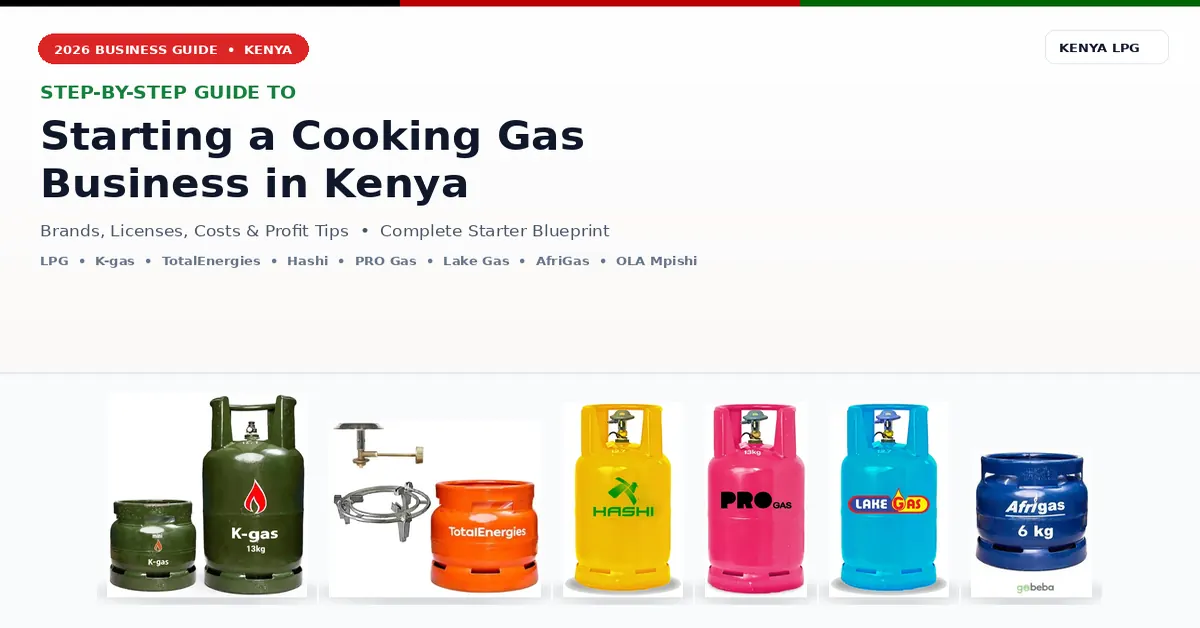
How to Start a Profitable Cooking Gas Business in Kenya – Daily Profit KES 9,940
Real numbers from KegasDealers.com – Empty cylinder KES 1,800 | Wholesale gas KES 110/kg | Retail refill 6kg KES 1,050 / 13kg KES 2,400
Current Gas Prices at KegasDealers.com (2026 Live Prices)
| Item | Price (KES) | Source |
|---|---|---|
| Empty K-Gas / Rubis 6kg Cylinder | 1,800 | kegasdealers.com |
| Empty ProGas 6kg Cylinder | 1,550 | kegasdealers.com |
| Empty K-Gas 13kg Cylinder | 3,500 | kegasdealers.com |
| Empty ProGas 13kg Cylinder | 2,700 | kegasdealers.com |
| K-Gas 6kg Complete Set (cyl+gas+burner+grill) | 3,400 | kegasdealers.com |
| ProGas 6kg Complete Set | 2,700 | kegasdealers.com |
| K-Gas 13kg Complete with Regulator + 2m Pipe | 5,500 | kegasdealers.com |
| ProGas 13kg Complete with Regulator + 2m Pipe | 4,800 (Offer) | kegasdealers.com |
| 6kg Refill (Retail) K-Gas | 1,050 | kegasdealers.com |
| 13kg Refill (Retail) Rubis | 2,450 (we use 2,400 in calc) | kegasdealers.com |
| Wholesale Refill Rate per KG | 110 per kg | kegasdealers.com – KES 110/kg |
💰 Daily Profit Breakdown for NEW Cooking Gas Business (Real Maths)
For people who are New in Cooking Gas business, If you sell 7 6kg refills, 3 13kg refills, 2 6kg gas cylinders complete sets, 1 13kg gas cylinders Complete Set and the accessories the daily profit will range From Ksh 5,000 to KSh 10,000.
1. Daily Profits for Gas Cylinders Refills
Currently the gas refill wholesale price is KSh 110, that means:
- 6kg gas cylinder wholesale refilling price is KSh 660 (110 × 6)
- 13kg gas cylinder wholesale refilling price is KSh 1,430 (110 × 13)
Sell 13kg Gas Cylinder Refill at KSh 2,4006kg profit: 1,050 – 660 = 390 × 7 = 2,730
13kg profit: 2,400 – 1,430 = 970 × 3 = 2,910
Daily Profits for gas cylinders refills is KSh 5,640
2. Daily Profits for Complete Sets
- 13kg Gas Cylinder Complete Set gets a profit of between KSh 1,200 to KSh 1,500
- 6kg gas cylinder complete set gets a profit of between KSh 500 to 900
1 × 13kg complete (avg KES 1,350) = 1,350 – 1,500
But using real KegasDealers margins: ProGas 6kg complete KES 2,700 sell at 3,400 = 700 profit, K-Gas 13kg complete 5,500 sell at 6,800 = 1,300
Daily Profits for gas cylinders complete sets will be KSh 3,400
3. Daily Profits for Gas Accessories
Regulators, hosepipes (2m rubber pipe), burner grills, lighters – profit like KSh 900 daily.
CUMULATIVE DAILY PROFIT
KSh 9,940
5,640 (refills) + 3,400 (complete sets) + 900 (accessories) = 9,940
Monthly (26 working days) = KES 258,440 | Yearly = KES 3.1M for new dealer doing 13 transactions/day
Step-by-Step How to Start
Step 1: Location Research (2 Days)
Find estate with 200+ houses, less than 2 dealers in 1km. Best near rentals, universities. Your target: 7x6kg + 3x13kg refills daily is easy in busy estate.
Step 2: Buy Empty Cylinders at KES 1,800
At KegasDealers, empty K-Gas/Rubis 6kg = KES 1,800 (your requested price). Buy 10 pcs = KES 18,000. ProGas empty 6kg KES 1,550 cheaper option. 13kg empties KES 2,700-3,500. We sell wholesale lots of 10 with free delivery to Nairobi, Mombasa, Embu, Nakuru, Eldoret.
Step 3: Stock Gas at KES 110/kg Wholesale
Wholesale = KES 110/kg. So 6kg = 660, 13kg = 1,430. You sell at 1,050 and 2,400. Keep gas stock for 2 days to avoid stockout.
Step 4: Price Complete Sets
Use KegasDealers retail as benchmark: K-Gas 6kg complete KES 3,400 sell at 4,100 (profit 700), ProGas 13kg complete KES 4,800 sell at 6,000 (profit 1,200). Include regulator + 2m pipe in price.
Step 5: Get Licensed
EPRA license KES 12k, county permit KES 8k, fire extinguisher KES 4,500, weighing scale KES 5k. Kegas helps with training certificate. Shop needs metal cage 3m from flame.
Step 6: Market & Sell 13 Transactions Daily
Flyers, estate WhatsApp groups, boda riders KES 50 referral, Google My Business. Offer delivery KES 100-200. Your math needs 13 customers/day to hit KES 9,940 – very achievable, estates have 500+ households refilling monthly.
❓ FAQs
How much is empty gas cylinder?
At KegasDealers: K-Gas/Rubis 6kg KES 1,800, ProGas 6kg KES 1,550, Afrigas 6kg KES 1,450, Hashi 6kg KES 1,300. 13kg empty KES 2,700-3,500. Sold in wholesale lots of 10.
What is wholesale gas price per kg?
KES 110 per kg at KegasDealers【6096212528984081735†L97-L101】. So 6kg = KES 660 wholesale, 13kg = KES 1,430 wholesale. Retail 6kg refill KES 1,050【6096212528984081735†L7-L11】, 13kg refill KES 2,450.
How much daily profit for new gas business?
KES 9,940 daily: Refills KES 5,640 (7×390 + 3×970) + Complete sets KES 3,400 (2×6kg + 1×13kg) + Accessories KES 900. Monthly KES 258k.
Start Your Gas Business with KegasDealers
EPRA Licensed Wholesaler Since Feb 2019 | Zanzibar Road, Kilindini, Mombasa
We supply K-Gas, ProGas, Afrigas, Total, Hashi, LakeGas, Seagas – 6kg, 13kg, 50kg
📲 WhatsApp: 0752221668
📞 Call to Order Empty Cylinders
Free delivery on 10+ cylinders | Wholesale lots | EPRA Sealed | Countrywide delivery
Related: 6kg Prices | Empty Cylinders | 13kg Cylinders | Last updated Aug 18, 2026 | KegasDealers Ltd
I am inquiring the business of dealing in different gas refiling business, so that i can serve clients with different needs.