Is Cooking Gas Business Profitable in Kenya? Real Profit Per Cylinder [2026]
Yes, cooking gas business is profitable in Kenya when you have a good location, reliable LPG supply, competitive pricing and enough daily sales volume. But the actual profit depends on your cylinder size, buying price, selling price, operating costs and number of customers.
If you are asking “is gas business profitable?”, “is gas refilling business profitable?” or “how profitable is cooking gas business in Kenya?”, this guide explains the numbers using KeGasDealers wholesale refill rates and realistic sales examples.
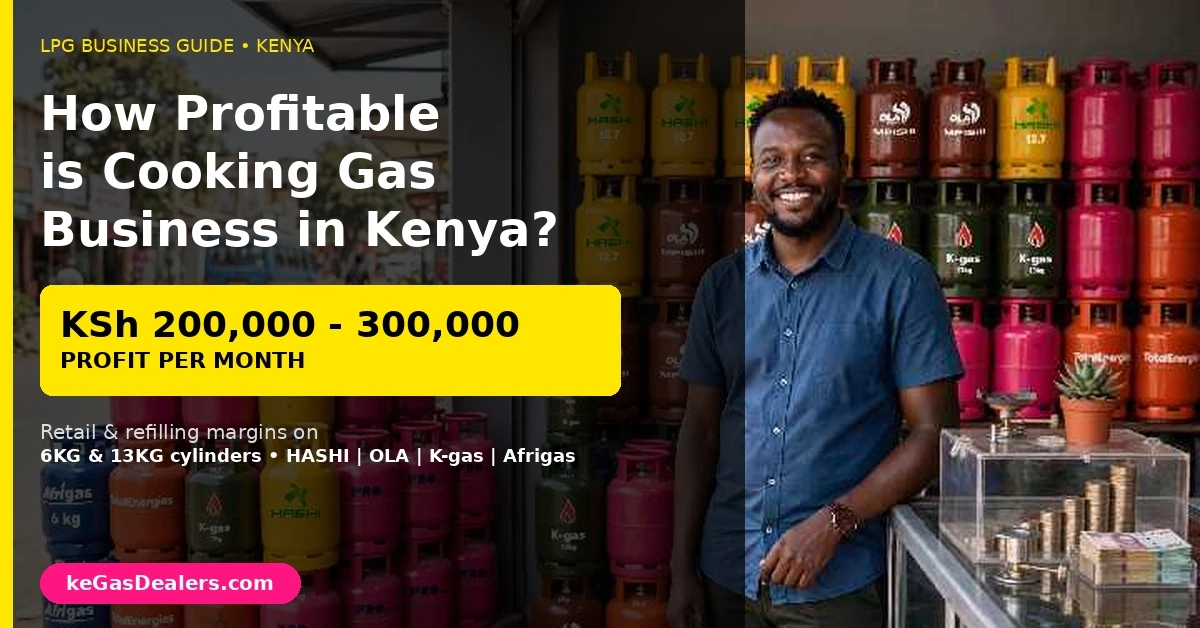
Cooking Gas Business Profit Snapshot – 2026
- 6kg refill profit: approximately Ksh 350–500
- 13kg refill profit: approximately Ksh 900–1,400
- Example daily gross profit: up to Ksh 9,000 at 15 refills per day
- Example monthly gross profit: up to Ksh 270,000 at the same sales volume for 30 days
- Important: actual net profit is lower after rent, salaries, permits, transport and other operating expenses.
Is Gas Business Profitable in Kenya?
Yes, a gas business can be profitable in Kenya. LPG is a repeat-purchase product because households, restaurants, hotels and other businesses regularly need refills.
However, profitability is not determined by the selling price alone. A profitable LPG business needs to control its wholesale cost, sell enough cylinders each day and keep operating expenses under control.
The most important numbers to monitor are:
- Wholesale LPG price per kilogram
- Retail price per cylinder
- Profit per 6kg, 13kg and 50kg refill
- Number of cylinders sold per day
- Monthly rent and employee costs
- Delivery and transportation costs
- Cost of permits and compliance
Before buying stock, it is useful to compare the latest gas cylinder prices in Kenya so you can estimate your starting investment and potential margin.
Gas Cylinder Profit Margin in Kenya in 2026
At KeGasDealers, dealers can access LPG at wholesale rates that vary according to brand, volume and current market conditions. For the example below, we use a wholesale refill rate of Ksh 110 per kg.
Retail prices vary depending on location, competition, brand and market conditions.
| Cylinder Size | Wholesale Refill Cost | Example Retail Price | Example Gross Profit |
|---|---|---|---|
| 6kg | Ksh 660 | Ksh 1,000–1,250 | Ksh 350–500 |
| 13kg | Ksh 1,430 | Ksh 2,400–2,800 | Ksh 900–1,400 |
| 50kg | Ksh 5,500 | Ksh 6,800–7,500 | Ksh 1,300–2,000 |
These are illustrative KeGasDealers rates and retail prices. LPG prices can change, and actual profit depends on your buying price, selling price, location and operating expenses.
For dealers who want to compare different brands and sizes, see our updated gas cylinders wholesale prices in Kenya.
How Much Profit Do You Make Per Gas Cylinder?
The profit per gas cylinder in Kenya depends primarily on cylinder size and the difference between your wholesale refill cost and retail selling price.
For example, if a 6kg refill costs you Ksh 660 and you sell it for Ksh 1,100, your gross trading profit is approximately Ksh 440.
If a 13kg refill costs Ksh 1,430 and you sell it for Ksh 2,500, your gross trading profit is approximately Ksh 1,070.
This is why 13kg cylinders can generate considerably more shillings in profit per transaction, although 6kg cylinders may have higher demand among smaller households.
For a current per-kilogram reference, check our current gas refill prices per kg in Kenya.
How Much Profit Can a Gas Business Make Per Day?
Consider an example of a busy estate LPG shop selling:
- 10 × 6kg refills per day
- 5 × 13kg refills per day
Using an average gross profit of Ksh 400 on a 6kg refill and Ksh 1,000 on a 13kg refill:
- 10 × Ksh 400 = Ksh 4,000 from 6kg refills
- 5 × Ksh 1,000 = Ksh 5,000 from 13kg refills
- Total example gross profit = Ksh 9,000 per day
At 30 trading days, that would equal approximately Ksh 270,000 in gross trading profit.
This should not be confused with net profit. If the shop spends Ksh 50,000 on rent, wages, transport, permits and other expenses, the amount remaining is much lower.
How Much Profit Does a Small Gas Business Make?
A beginner should not assume that a new gas shop will immediately sell 15 cylinders every day.
A small shop in a low-traffic location may initially sell only a few refills per day. For example, if you make an average gross profit of Ksh 150 per cylinder and sell 10 cylinders, your gross profit would be around Ksh 1,500 per day.
As your customer base grows, repeat customers can make a major difference.
The key question is therefore not only “how much profit does a gas business make?” but also “how many cylinders can I realistically sell every day?”
Is Gas Refilling Business Profitable in Kenya?
Yes, gas refilling business can be profitable, especially when you purchase LPG at a competitive wholesale price and operate in an area with regular demand.
A refill business can generate income from the margin between your LPG acquisition cost and the amount charged to customers. The business becomes more attractive as daily sales volume increases and fixed costs are kept under control.
Your profitability depends on:
- Your wholesale LPG price
- Your daily refill volume
- Your retail selling price
- Location and customer traffic
- Rent and labour costs
- Transport and delivery expenses
- Compliance and licensing costs
If you want to start with limited capital, read our detailed guide on how to start a gas refill business in Kenya with Ksh 50,000.
How Profitable Is Cooking Gas Business in Kenya?
The profitability of a cooking gas business varies considerably from one shop to another.
A shop selling 10–15 cylinders per day can generate meaningful gross margins, but a shop with low sales volume may struggle after paying rent and other expenses.
For example:
| Daily Sales | Illustrative Gross Profit | Illustrative Monthly Gross Profit |
|---|---|---|
| 5 cylinders | Ksh 1,000–3,000 | Ksh 30,000–90,000 |
| 10 cylinders | Ksh 2,000–6,000 | Ksh 60,000–180,000 |
| 15 cylinders | Ksh 4,000–9,000 | Ksh 120,000–270,000 |
These figures are illustrations rather than guaranteed earnings. Your actual results depend on the mix of 6kg, 13kg and larger cylinders and your actual margin per refill.
Is LPG Gas Business Profitable in Kenya?
LPG gas business can be profitable when demand, pricing and operating costs are managed correctly.
LPG has an important advantage over many ordinary retail products: customers need to purchase refills repeatedly. Building a strong base of loyal households, restaurants and other commercial customers can therefore create recurring sales.
If you are researching the business before investing, our guide to wholesale gas cylinder suppliers in Kenya can help you understand how wholesale sourcing works.
Gas Business Requirements in Kenya
Before starting a gas business, you need to understand the requirements for operating an LPG retail or refilling business legally and safely.
Depending on the type and scale of your operation, requirements may include:
- Appropriate business premises
- County business permits
- Relevant LPG regulatory approvals and compliance
- Suitable fire-safety equipment
- Approved cylinder storage arrangements
- Proper weighing and handling equipment where applicable
- Reliable LPG supplier
- Working capital for stock and operating expenses
Read our detailed guide to the requirements to start an LPG gas business in Kenya before committing money to premises or stock.
Always confirm the latest requirements with the relevant authorities before opening because licensing and safety requirements can change.
How Much Do You Need to Start a Gas Refill Business?
The amount needed depends on whether you are starting a small retail operation, a refill point or a larger distribution business.
Your startup budget may need to cover premises, permits, equipment, cylinders, initial LPG stock, branding, transport and working capital.
One practical way to reduce your initial capital requirement is to start with a focused selection of fast-moving cylinder sizes rather than purchasing too much slow-moving stock.
For entrepreneurs looking for stock, our K-Gas empty cylinders wholesale page provides current bulk cylinder options.
Factors That Determine Gas Business Profit in Kenya
1. Wholesale LPG Price
Your buying price has a direct effect on your gross margin. The lower your legitimate wholesale cost, the more room you have to compete while maintaining a margin.
2. Daily Gas Cylinder Sales
Volume is one of the most important factors. A shop making Ksh 400 on a cylinder and selling 20 cylinders has a very different monthly result from a shop making the same margin but selling only three cylinders.
3. Location of Your Gas Shop
A location near residential estates, restaurants, hotels or other regular LPG users can generate more repeat customers.
4. Customer Retention
Repeat customers reduce the amount you need to spend attracting new buyers. A household that refills every few weeks can become a valuable long-term customer.
5. Home Gas Delivery
Gas delivery can increase convenience and help you capture customers who prefer ordering by phone or WhatsApp. You can charge a delivery fee where appropriate.
6. Gas Accessories and Complete Sets
You can increase revenue by selling related products such as regulators, burners, hoses and complete LPG sets.
For example, customers starting from scratch may be interested in a 13kg Afrigas complete gas cylinder set with the cylinder, gas, regulator and hosepipe.
7. Rent, Labour and Other Expenses
High operating costs can eliminate an otherwise attractive gross margin. Calculate your monthly break-even point before choosing a location.
How Much Profit Does a Gas Distributor Agency Make?
A gas distributor agency operates at a different level from a small retail gas shop.
A distributor may earn from:
- LPG volume margins: buying LPG at wholesale prices and supplying smaller dealers.
- Gas cylinder sales: supplying empty cylinders to retailers and other customers.
- Bulk or commercial customers: supplying restaurants, institutions, hotels and other high-volume users.
For example, at an illustrative margin of Ksh 10–20 per kg, moving 5,000kg of LPG in a month would produce Ksh 50,000–100,000 in gross LPG margin before operating costs.
Distributor profitability therefore depends heavily on volume, supplier pricing, logistics and customer acquisition.
Gas Cylinder Business Profit vs Gas Refilling Business
There is an important difference between selling empty cylinders and operating an LPG refill business.
With a refill business, your main trading margin comes from buying LPG and selling the refill to customers.
With cylinder sales, you make money from the margin on the physical cylinder itself.
If you need cylinder stock for your new business, you can also browse the empty gas cylinders wholesale category for different brands and sizes.
Is Selling Gas Profitable for Beginners?
Yes, selling gas can be profitable for beginners, but starting small and controlling costs is important.
A beginner should focus on three things:
- Find a location with genuine customer demand.
- Secure a reliable and competitive LPG supplier.
- Track every sale and expense from the first day.
Do not judge the business only by the amount of cash coming into the shop. Calculate your actual gross margin and subtract all monthly expenses to determine your true net profit.
Frequently Asked Questions About Gas Business Profit in Kenya
Is cooking gas business profitable in Kenya?
Yes. A cooking gas business can be profitable in Kenya because LPG is a repeat-purchase product. Your actual profit depends on wholesale cost, retail price, sales volume, location and operating expenses.
Is gas refilling business profitable in Kenya?
Yes. Gas refilling can be profitable when you buy LPG at a competitive wholesale price and maintain sufficient daily sales volume. The most important factors are refill margin, sales volume and operating costs.
How much profit do you make on a 6kg gas cylinder?
At an example wholesale rate of Ksh 110 per kg, a 6kg refill costs Ksh 660. If sold for Ksh 1,000–1,250, the illustrative gross profit is approximately Ksh 350–500 per refill.
How much profit do you make on a 13kg gas cylinder?
At Ksh 110 per kg, a 13kg refill costs approximately Ksh 1,430. If sold for Ksh 2,400–2,800, the illustrative gross profit is approximately Ksh 900–1,400.
How profitable is cooking gas business in Kenya?
Profitability varies by location and sales volume. A busy shop selling a combination of 6kg and 13kg cylinders can generate several thousand shillings in gross profit per day, but net profit will be lower after operating expenses.
How much do I need to start a gas refill business in Kenya?
Startup capital depends on the size and type of business. You need to budget for premises, cylinders, equipment, permits, LPG stock, transport and working capital. See our Ksh 50,000 gas refill business guide for a small-startup approach.
What are the requirements for starting a gas business in Kenya?
Requirements can include suitable premises, county permits, applicable LPG approvals, fire-safety measures, compliant storage facilities, equipment and a reliable LPG supplier. Always verify the current requirements with the relevant authorities before starting.
Is selling gas profitable?
Yes. Selling gas can be profitable if your selling price provides enough margin above your wholesale cost and you achieve sufficient daily sales. Repeat customers and delivery services can also improve the economics.
How much profit does a gas distributor agency make?
A distributor’s profit depends on LPG volume, margin per kilogram, cylinder sales, logistics and operating costs. For example, a Ksh 10–20 per kg margin on 5,000kg of monthly sales would represent Ksh 50,000–100,000 in gross LPG margin before expenses.
Which gas cylinder size is most profitable to sell?
There is no single cylinder size that is always the most profitable. A 13kg cylinder can provide a higher shilling profit per refill, while 6kg cylinders may have strong demand in residential areas. The best choice depends on your customers, location, wholesale price and sales volume.
Can I start a gas business with Ksh 50,000?
A lean LPG retail setup may be possible with Ksh 50,000, but your actual startup cost depends on premises, compliance, equipment, cylinders, initial stock and working capital. Read our detailed guide to starting a gas refill business with Ksh 50,000.
Where can I buy gas cylinders wholesale in Kenya?
KeGasDealers supplies wholesale LPG cylinders and related stock, including K-Gas, Afrigas, ProGas and other brands. See the gas cylinders wholesale price list or contact the sales team for current bulk pricing.
Ready to Start a Gas Business?
Build your LPG business with reliable wholesale supply and genuine gas cylinders.
View Wholesale K-Gas Cylinders
WhatsApp 0752221668 for stock and delivery information.
I need to start I live in Taveta Kenya. Pls do communicate. Am very ready
Kindly share your contact number
Kindly share your contact number
Best regards
Hello am godffrey ready to start but I don’t have any idea.
great information.
i need to start a business too. ready
Hi i would Like To Start These Business,,,Advise Further please
Iam Interested In These Business ,Kindly advise Further
How much do I need to start that business in 7moja