LPG Gas Business Requirements in Kenya 2026: 6 Licences, Costs & EPRA Steps
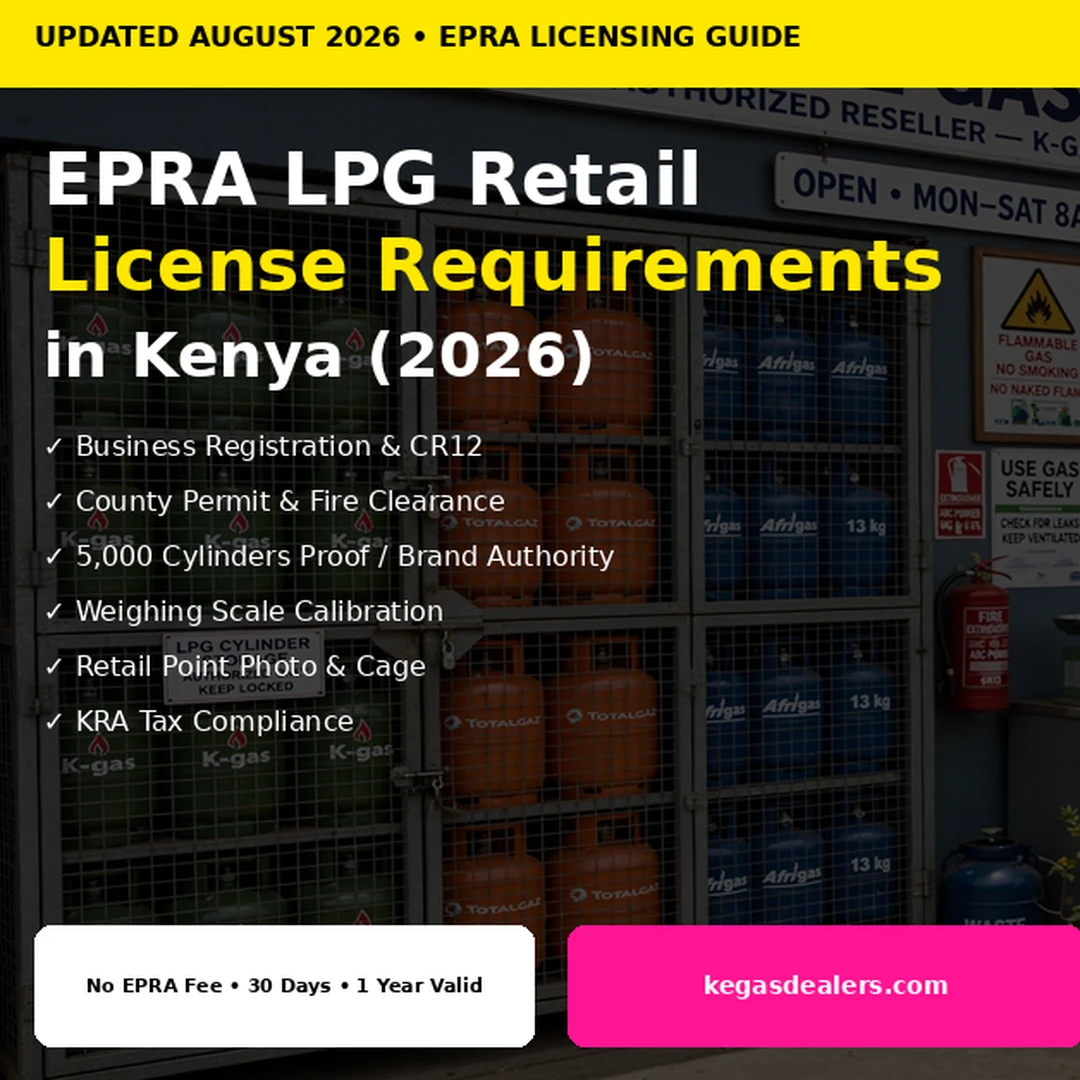
Direct answer: Starting an LPG gas business in Kenya requires six documents — an EPRA retail licence, a county unified business permit, a county fire clearance certificate, a KRA PIN and tax compliance certificate, a weights and measures certificate, and brand authorization letters. Licences cost KSh 5,000–10,000 in total, and the full startup budget is KSh 80,000–150,000.
This guide covers the exact licences, fee ranges, issuing authorities and equipment needed to open a compliant LPG retail or refill business in Kenya in 2026. Every figure below is stated in Kenyan Shillings (KSh). KegasDealers supplies the brand authorization letter and EPRA compliance documentation package at no extra cost on the initial stock order.
What Are the 6 Mandatory Gas Business Requirements in Kenya?
Direct answer: The six mandatory requirements to start an LPG gas business in Kenya are the EPRA retail licence, the county unified business permit, the county fire clearance certificate, a KRA PIN with tax compliance certificate, a weights and measures certificate, and brand authorization letters from each LPG brand stocked.
| Requirement | Issuing Authority | Typical Fee (KSh) | Renewal |
|---|---|---|---|
| EPRA LPG Retail Licence | Energy and Petroleum Regulatory Authority (EPRA) | 0–3,000 | Annual |
| County Unified Business Permit | County Government (Nairobi, Kiambu, Nakuru, Machakos) | 2,500–5,000 | Annual |
| County Fire Clearance Certificate | County Fire and Rescue Department | ~1,000 | Annual |
| KRA PIN and Tax Compliance | Kenya Revenue Authority (KRA) | 0 | Annual return |
| Weights and Measures Certificate | Weights and Measures Department | ~500 | Annual |
| Brand Authorization Letter | LPG brand owner (K-Gas, Total Gas, Afrigas, ProGas) | 0 | Per supplier agreement |
1. EPRA LPG Retail Licence
Direct answer: The EPRA LPG retail licence is issued by the Energy and Petroleum Regulatory Authority and is the primary legal requirement to sell or refill LPG cylinders in Kenya. The application requires a premises layout, safety documentation and a letter from a licensed LPG supplier.
The EPRA licence fee varies by activity type and cylinder storage capacity; a small retail kiosk typically pays KSh 0–3,000 annually. Approval takes approximately 2–4 weeks from submission of complete documents. Operating without an EPRA licence is an offence under the Petroleum Act 2019 and carries fines of up to KSh 100,000 plus stock confiscation.
Step 1: Register the business name with the Business Registration Service and obtain a KRA PIN.
Step 2: Secure premises with open-air ventilation and a caged cylinder storage area.
Step 3: Install a certified 6kg dry chemical fire extinguisher and mount it visibly.
Step 4: Confirm there are no open fires, welding workshops or schools within 15 metres of the storage point.
Step 5: Create an account on the EPRA licensing portal and submit business documents, premises photos and a supplier letter.
Step 6: Pay the licence fee, attend the EPRA inspection and display the licence at the premises.
2. County Unified Business Permit
Direct answer: The county unified business permit is the trading licence issued by the county government where the LPG shop is located. The annual fee ranges from KSh 2,500 to KSh 5,000 depending on the county and shop size.
Nairobi, Kiambu, Nakuru and Machakos counties all operate under the unified business permit system and accept a single application covering trade, fire and signage. Applicants must attach the KRA PIN certificate, the EPRA licence and the fire clearance certificate to the county application.
3. County Fire Clearance Certificate
Direct answer: The county fire clearance certificate confirms that the LPG premises meet Kenya fire safety standards. The certificate costs approximately KSh 1,000 annually and requires a serviced fire extinguisher, visible safety signage and an unobstructed exit route.
EPRA will not approve an LPG retail licence without a valid county fire clearance certificate. The certificate is issued after a county fire officer inspects the premises and confirms the extinguisher service tag is current.
4. KRA PIN and Tax Compliance Certificate
Direct answer: A KRA PIN is required to register any business in Kenya and to apply for a county business permit. A Tax Compliance Certificate confirms that all statutory returns are filed and is required for EPRA licence renewal.
5. Weights and Measures Certificate
Direct answer: The weights and measures certificate confirms that the LPG shop’s weighing scale is accurate and legally compliant. The certificate costs approximately KSh 500 annually and requires a certified scale that is verified by a Weights and Measures Department inspector.
The scale proves that every 6kg or 13kg refill delivered to a customer is the stated weight. This protects the retailer against consumer complaints and county fines, and it is checked during the EPRA inspection.
6. Brand Authorization Letters
Direct answer: Brand authorization letters are issued by the LPG brand owner and confirm that the retailer is an approved stockist of that brand. Stocking K-Gas, Total Gas, Afrigas or ProGas cylinders without written authorization exposes the retailer to anti-counterfeit enforcement action and stock seizure.
KegasDealers supplies authorization letters for every brand stocked at no additional cost on the initial order. The letter must be displayed on the premises alongside the EPRA licence.
How Much Do I Need to Start a Gas Refill Business in Kenya?
Direct answer: Starting a gas refill business in Kenya costs KSh 80,000–150,000 for a shop stocking 20–30 mixed 6kg and 13kg cylinders, including all licences, safety equipment and the initial cylinder stock. A minimal refill point with 10 cylinders can start at approximately KSh 50,000.
| Cost Item | Small (10 cylinders) | Standard (30 cylinders) |
|---|---|---|
| Empty cylinder stock | 30,000–45,000 | 60,000–120,000 |
| Licences and permits (6 items) | 5,000–10,000 | 5,000–10,000 |
| Weighing scale | 3,500 | 3,500 |
| Fire extinguisher (6kg dry chemical) | 4,500 | 4,500 |
| Cylinder cage or grill | 10,000 | 10,000 |
| Shop branding | 5,000 | 5,000 |
| Total | ~50,000 | 80,000–150,000 |
Empty cylinder stock is the largest single cost. Current KegasDealers wholesale rates are KSh 1,300–1,750 for a 6kg empty cylinder and KSh 2,500–3,500 for a 13kg empty cylinder. See the gas cylinders wholesale prices in Kenya 2026 page for brand-by-brand rates.
Operating capital covers refills at KSh 110/kg, delivery and the first month of working expenses. The start a gas refill business in Kenya with KSh 50,000 guide breaks down the minimal model line by line.
How much money is required to open a gas agency in Kenya?
Direct answer: Opening a gas agency in Kenya requires KSh 50,000 for a minimal 10-cylinder refill point and KSh 80,000–150,000 for a standard 30-cylinder shop with all six licences, fire safety equipment and cylinder stock. The licence component alone costs KSh 5,000–10,000.
What Do You Need to Start a Gas Refill Business in Kenya? Equipment Checklist
Direct answer: A gas refill business in Kenya needs a ventilated shop of at least 10 by 10 feet with a concrete floor, a cylinder cage or grill for outdoor storage, an approved weighing scale, a certified 6kg dry chemical fire extinguisher, and an initial stock of 6kg and 13kg cylinders from authorized brands.
- Ventilated shop: at least 10 by 10 feet with a concrete floor and open-air ventilation.
- Cylinder cage or grill: outdoor steel cage for cylinder storage, positioned at least 15 metres from open flames.
- Weighing scale: certified by the Weights and Measures Department for refill verification.
- Fire extinguisher: 6kg dry chemical, mounted visibly, serviced annually.
- Initial cylinder stock: a mix of 6kg and 13kg cylinders from K-Gas, Total Gas, Afrigas and ProGas.
- Regulators and hoses: 20mm unified screw-on regulators for standard steel cylinders and 27mm quick-release clip-on regulators for composite cylinders.
- Licensed wholesale supplier: a supplier who provides the brand authorization letter and EPRA documentation support.
Which gas cylinder valve type should a new dealer stock in Kenya?
Direct answer: A new LPG dealer in Kenya should stock regulators for both the 20mm unified screw-on valve used on standard steel 6kg and 13kg cylinders and the 27mm quick-release clip-on valve used on composite cylinders. Carrying both regulator types prevents lost sales when a customer arrives with either cylinder format.
How Do I Get an EPRA Gas Licence in Kenya? Step-by-Step
Direct answer: An EPRA gas licence in Kenya is obtained by registering the business, securing compliant premises, creating an EPRA portal account, submitting business and safety documents, paying the licence fee and passing the EPRA inspection. Approval typically takes 2–4 weeks.
- Step 1: Register the business name with the Business Registration Service and obtain a KRA PIN.
- Step 2: Secure premises that meet EPRA ventilation, storage and 15-metre separation requirements.
- Step 3: Purchase and service the fire extinguisher, and obtain the county fire clearance certificate.
- Step 4: Obtain the county unified business permit and the weights and measures certificate.
- Step 5: Request the brand authorization letter and supplier letter from the LPG wholesale supplier.
- Step 6: Create an EPRA licensing portal account and submit the documents with premises photographs.
- Step 7: Pay the EPRA licence fee and attend the inspection.
- Step 8: Display the EPRA licence and brand authorization letters at the premises and renew annually.
Which LPG Brands Should a New Gas Dealer Stock in Kenya?
Direct answer: A new LPG dealer in Kenya should stock K-Gas, Total Gas, Afrigas and ProGas as the core brands, because these four have the largest refill networks and highest customer recognition. ProGas offers the lowest refill price at approximately KSh 2,250 for a 13kg refill, while K-Gas and Total Gas have the widest station coverage.
| Brand | Empty 6kg (KES) | Empty 13kg (KES) | Dealer Advantage |
|---|---|---|---|
| K-Gas | 1,750 | 3,200–3,500 | Largest refill network, high brand loyalty |
| Total Gas | 1,750 | 3,200–3,500 | Widest station coverage, KEBS certified |
| Afrigas (Shell) | 1,450 | 2,700–3,000 | Premium positioning, safety reputation |
| ProGas | 1,450 | 2,700 | Lowest refill price, high turnover |
| Hass | 1,450 | 2,700–3,000 | Mid-tier pricing, growing network |
| Hashi / Lakegas / Mengas / Taifa Gas | 1,300 | 2,500 | Budget tier, better dealer margin |
Which gas business is most profitable in Kenya?
Direct answer: The most profitable gas business model in Kenya is a refill exchange business that combines cylinder sales with a recurring refill customer base, because refills generate KSh 340–450 profit per 6kg cylinder and KSh 800–1,200 per 13kg cylinder with low additional storage cost.
The is the cooking gas business profitable in Kenya page covers margin modelling. The how much you need to start a gas business in Kenya page covers larger formats.
Frequently Asked Questions About Starting a Gas Business in Kenya
What are the main gas business requirements in Kenya?
Six documents are required: an EPRA LPG retail licence, a county unified business permit, a county fire clearance certificate, a KRA PIN with tax compliance certificate, a weights and measures certificate, and brand authorization letters for every LPG brand stocked.
How much do I need to start a gas business in Kenya?
Starting a gas business in Kenya costs KSh 50,000 for a minimal 10-cylinder refill point and KSh 80,000–150,000 for a standard shop stocking 30 mixed 6kg and 13kg cylinders. Empty cylinder stock is the largest cost item, followed by licences at KSh 5,000–10,000.
How much do I need to start a gas refill business in Kenya?
A gas refill business in Kenya needs KSh 80,000–150,000 for 20–30 cylinders including licences, a weighing scale, a fire extinguisher and a storage cage. A 10-cylinder refill point can start at approximately KSh 50,000.
What is the gas agency licence cost in Kenya?
There is no single gas agency licence fee. The combined cost is KSh 2,500–5,000 for the county business permit, approximately KSh 1,000 for fire clearance, approximately KSh 500 for weights and measures, and KSh 0–3,000 for the EPRA retail licence. Total: KSh 5,000–10,000.
How do I get an LPG gas licence in Kenya?
Apply through the EPRA licensing portal with business registration documents, county permits, premises photographs, a fire extinguisher receipt and a letter from an LPG supplier. Approval takes approximately 2–4 weeks and requires passing an EPRA premises inspection.
Can I start a gas refill business without an EPRA licence?
No. Operating a retail gas business in Kenya without a valid EPRA licence or brand authorization letters is an offence under the Petroleum Act 2019. Penalties include immediate closure, confiscation of cylinder stock and fines of up to KSh 100,000.
Why do I need a weights and measures certificate for gas refills?
The weights and measures certificate confirms that the shop’s weighing scale is accurate, so every 6kg or 13kg refill contains the stated weight of LPG. The certificate protects customers, prevents county fines and is checked during the EPRA inspection.
Which LPG brands should a new gas dealer stock in Kenya?
A new LPG dealer in Kenya should stock K-Gas, Total Gas, Afrigas and ProGas as core brands, because these four have the largest refill networks and highest customer recognition. ProGas offers the lowest 13kg refill price at approximately KSh 2,250.
How long does EPRA licence approval take in Kenya?
EPRA licence approval in Kenya typically takes 2–4 weeks from submission of complete documents, assuming the premises pass the inspection on the first visit. Incomplete premises documentation is the most common cause of delay.
Order LPG Cylinder Stock and Get Free EPRA Documentation from KegasDealers
Direct answer: KegasDealers supplies LPG cylinder stock to new dealers in Kenya from Mombasa, Kilindini Zanzibar Rd opposite Elite Tools Limited, and provides the brand authorization letter and EPRA compliance documentation package free with the initial stock order.
Contact KegasDealers for Dealer Stock and Licensing Support
Confirm current cylinder stock, wholesale rates and the free licensing documentation package with the KegasDealers dealer team.
- Location: Mombasa, Kilindini Zanzibar Rd opposite Elite Tools Limited
- Refill rate: KSh 110/kg
- Payment: M-Pesa Buy Goods Till
- Delivery: Countrywide, free from 10 cylinders; 1-hour Nairobi Metropolitan
- Compliance: EPRA Dealer Licence and brand authorization letter provided free
Last verified: . Licence fees, EPRA requirements and LPG prices change. Confirm current figures with the issuing authority and your LPG supplier before applying.